Introduction
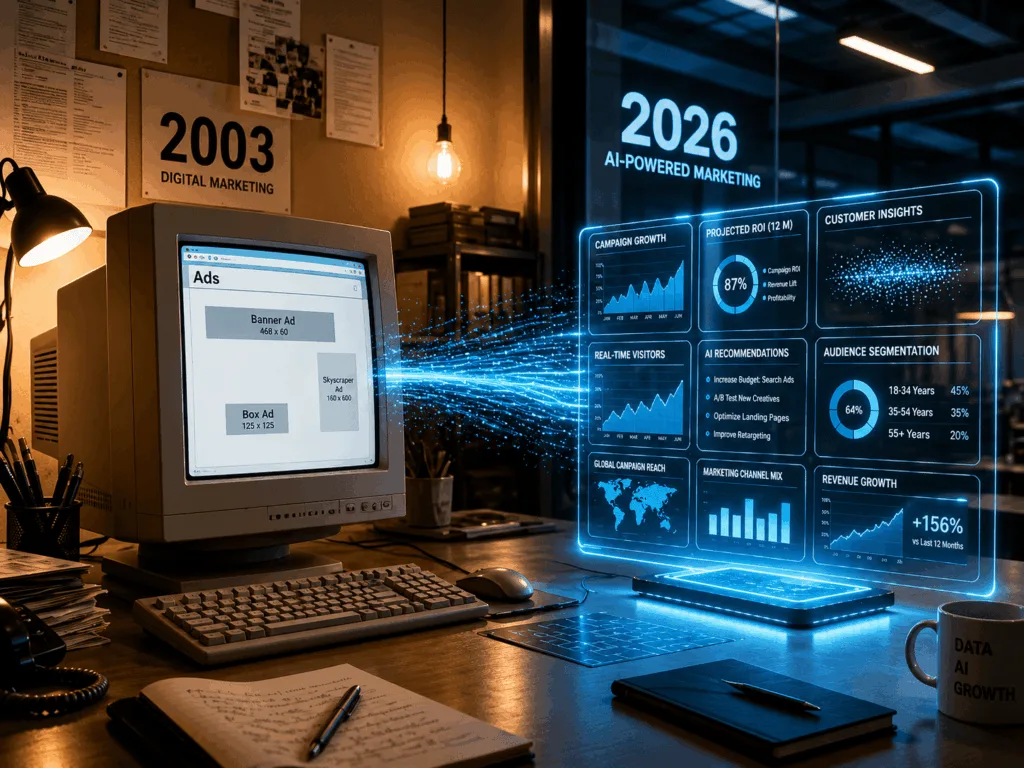
Since Human Advertising began in 2003, the advertising and digital landscape has transformed. What started as a world shaped by print, design, brand identity, and early websites is now fast-moving, driven by data, mobile, social media, automation, privacy, performance marketing, and AI.
For a small studio, this change was direct and tangible. It shaped how work was created, delivered, measured, and improved. Over 23 years, Human evolved—not by chasing every trend, but by identifying changes that truly mattered to clients, brands, and audiences.
This timeline illustrates not only how the industry has transformed since 2003, but also how each change set the stage for Human’s continual adaptation and embrace of technology. Each era brought new challenges and opportunities, shaping both humans’ path and the broader advertising landscape.
Advertising and Technology Timeline: 2003 to Today
2003 — Human Begins
Human began its journey at a time when much of the advertising world was still rooted in traditional creative, print, design and brand communication.
Websites existed, but most were still treated as digital brochures. At the same time, Google launched AdSense, helping create an early online advertising infrastructure.
For Human, these years form a creative foundation that the studio would build on as the industry evolved: strong ideas, design thinking, brand development and practical communication that prepared Human for the digital wave ahead.
2004 — Social Platforms Begin to Reshape Attention
Facebook launched in 2004. Social platforms weren’t initially serious advertising channels, but they changed how people spent time online and how communities formed around interests and brands.
For small studios and creative companies, this was the start of a major shift and a signal to prepare for new ways of reaching audiences. The move from scheduled media buys to emerging online communities would soon reshape strategies and practices across the industry.
2005 — Measurement Becomes Mainstream
Google acquired Urchin and launched Google Analytics. This changed the conversation for everyday businesses.
Marketing was no longer judged just by looks or placement. Clients demanded results: visits, sources, and next steps.
For humans, this technology shift was the first of many changes that would intertwine creativity with evidence, tracking and performance—foreshadowing how future advances would keep raising expectations for both process and results.
2005–2006 — Online Video Starts to Become Normal
YouTube launched in 2005 and was acquired by Google in 2006. This helped turn online video from a novelty into a future mass advertising channel.
Publishing, sharing, and promoting video online changed the way brands tell stories. Video was no longer limited to TV budgets or major media buys, and it became part of websites, social media, campaigns, and everyday content.
For Human, this was not just a technical transition, but the opening of a creative frontier. Video-driven storytelling would soon become an essential part of the wider shift toward multi-channel digital content, preparing the studio for what was to come.
2007 — Mobile Changes Everything
Apple introduced the iPhone in 2007. This permanently changed the rhythm of marketing.
Websites were now accessible from anywhere—on the go, while shopping or comparing—enabling real-time decision-making.
For Human, this mobile revolution redefined web design. Adapting to new expectations for access and speed would set a precedent for handling further industry changes, guiding the studio’s approach to later developments.
2007 — Platform Advertising Becomes More Structured
Facebook introduced Facebook Ads in 2007. This helped move digital advertising away from simply buying space on websites and towards reaching specific audiences through data, interests and behaviour.
At the same time, Google’s DoubleClick acquisition pointed towards the industrialisation of digital advertising infrastructure.
For small studios, platform advertising presented new challenges and opportunities—requiring adaptation not just in creative execution but also in understanding technical requirements. This shift laid the foundation for the growing convergence of creativity and technology in the years to follow.
2010 — Programmatic Advertising Begins to Mature
The OpenRTB consortium began developing open standards for real-time bidding in 2010. This became part of the foundation for programmatic advertising.
Digital media buying grew more automated and technical, depending not just on creativity but also on data, bidding, and optimisation.
For Human, this shift toward technological integration signaled a future where marketing, data, and automation would only grow more interconnected—a trend that would define the next decade of industry evolution.
2011 — Online Marketing Becomes More Regulated
The UK Advertising Standards Authority extended its remit to cover advertisers’ own websites and other non-paid online spaces under their control.
Websites, social pages, and owned content could no longer exist outside advertising rules; claims, messaging, and presentation now mattered.
For Human, this expansion of regulation reinforced the importance of responsible communication, emphasizing that persuasive digital content would need careful attention to accuracy and professional standards as regulations continued to evolve.
2015 — Mobile Usability Becomes a Search Issue
Google rolled out its mobile-friendly update in 2015, making mobile usability a more direct ranking consideration in mobile search.
Mobile was essential. A poor mobile experience can harm visibility, conversion rates, and brand perception.
For Human, this marked the time when responsive design, mobile-first thinking and user experience became industry standards. Mastering these essentials prepared the studio to navigate future shifts in digital expectations.
2017 — Digital Becomes the Majority in the UK
By 2017, internet advertising accounted for more than half of all UK advertising expenditure.
This was a major industry milestone. It confirmed that attention, behaviour and budgets had moved online. Digital was no longer the emerging channel. It had become the primary environment in which many businesses competed.
For Human, this milestone further validated the studio’s direction. With digital now at the centre of brand growth, Human was positioned to meet the next wave of industry changes head-on.
2018 — GDPR Changes the Data Conversation
GDPR became applicable from 25 May 2018. This changed how businesses thought about data, consent, tracking, storage and communication.
Marketing teams and studios could no longer treat data collection as a background technical issue. Privacy became part of the operational and strategic conversation.
For Human, GDPR brought a new level of consideration to digital work, making compliance and trust a day-to-day priority. This sharpened focus on ethics and rigor would influence every future innovation and technological shift.
2018 — Accessibility Becomes More Important
UK public sector accessibility requirements came into sharper focus, with websites and apps needing to meet accessibility standards and publish accessibility statements.
Websites should look good and be usable by as many people as possible, reflecting higher digital standards.
For Human, accessibility became a key aspect of professional digital delivery—an approach aligned with the growing call for digital inclusion, which would become increasingly central in future standards and practices.
2018 — Mobile-First Indexing Reinforces the Mobile Web
Google began rolling out mobile-first indexing, meaning the mobile version of a website became central to how content was indexed and ranked.
This further confirmed that mobile was no longer a secondary version of the website. In many cases, it was the primary version.
For Human, this priority on mobile-first design solidified the need to continually adapt to evolving user behavior—not just reacting to technology shifts but proactively shaping user-centered solutions.
2019–2020 — Programmatic Becomes the Default for Display
Programmatic display advertising continued to grow and became the dominant way in which much digital display media was traded.
Advertising became more automated, data-led, and reliant on platform knowledge. Campaigns required constant monitoring and refinement.
For Human, this shift solidified the blend of creative, technical and analytical skills as essential for meaningful client support—preparing the studio for the increasingly complex digital environment ahead.
2020 — Web Performance Becomes a Shared Language
Google introduced Web Vitals, creating clearer guidance around key quality signals for user experience.
Speed, responsiveness and visual stability became easier to discuss and measure. Performance was no longer only a developer issue. It affected SEO, user experience, conversion and trust.
For Human, these developments further bridged design, development and marketing performance, confirming that an integrated approach would be crucial for meeting business objectives in the digital era.
2020 — Google Analytics Begins Its Next Generation
Google introduced the new Google Analytics, setting the direction for GA4.
This signalled a measurement shift. Businesses needed better cross-platform tracking, event reporting, and more flexible insights into user journeys.
For Human, this period underscored that measurement is always evolving. Staying ahead of tool changes and client expectations remains vital, with adaptability key to maintaining valuable reporting in the long term.
2021 — Apple ATT Disrupts Attribution
Apple’s App Tracking Transparency framework changed how tracking worked across iOS apps. Apps had to ask permission to track, and many users chose not to allow it.
This made digital attribution more complex, as advertisers and agencies needed to reconsider their reliance on platform data. The evolving digital landscape continued to require fresh strategies and adaptive thinking.
For Human, this reinforced the importance of building more durable marketing systems. Good digital strategy could not depend entirely on one platform’s tracking.
2021 — Page Experience Becomes More Closely Linked to Search
Google began rolling out Page Experience signals, including Core Web Vitals, into its search ranking considerations.
This pushed the industry further towards measurable website quality. Search visibility, user experience and technical performance became more closely connected.
For Human, this supported a joined-up approach: design, development, content, SEO and performance all had to work together.
2023 — Universal Analytics Stops Processing New Data
Universal Analytics stopped processing new data in July 2023, forcing many businesses to migrate fully to GA4.
This was a major operational change for websites, marketing teams and agencies. Reports, goals, events and conversions all had to be reconsidered.
For Human, this was another example of why digital work needs ongoing management. A website is not finished when it goes live. The tools around it continue to change.
2024–2025 — Privacy, Cookies, and User Choice Keep Changing
Google changed direction around Privacy Sandbox and third-party cookies, placing more emphasis on user choice.
This period showed that privacy, tracking and advertising technology remained unsettled. Businesses needed to be ready for continued change in how audiences were measured and reached.
For Human, this reinforced the value of flexible thinking. The future of digital marketing would depend on first-party data, better content, stronger websites, clearer reporting and smarter use of technology.
2023–Present — AI Becomes a Practical Creative and Technical Tool
Artificial intelligence moved rapidly into everyday business use. Tools such as GPT and other AI models began helping digital companies write, research, code, prototype, analyse, plan and solve problems faster.
For Human, AI is not simply a trend. It has become another tool in the studio: supporting developers, helping with content structure, speeding up research, assisting with technical problem-solving and allowing smaller teams to take on work that may once have required much larger resources.
AI does not replace the need for experience, judgement or creativity. But it does change the speed at which ideas can be explored and delivered.
What Changed for the Small Studio
For the small studio, the last 23 years have not been about one single transformation. They have been about constant adaptation.
First, marketing became measurable. Clients began asking not only whether something looked good, but whether it worked.
Then the web became mobile. The website stopped being a static brochure and became the shopfront, sales tool and first point of contact carried in every customer’s pocket.
Then, the platforms changed distribution. Facebook, Google, YouTube and programmatic advertising changed how audiences were reached, tested and influenced.
Then, regulation and privacy changed the rules. GDPR, cookie consent, tracking restrictions and platform changes made measurement more complex and more important to manage properly.
Then performance became part of visibility. Speed, usability, accessibility, and user experience began to affect not only conversion rates but also search competitiveness.
Now AI is changing the workflow again. It is helping smaller digital companies work faster, think wider, solve technical problems, produce more efficiently and explore projects that may previously have felt out of reach.
For Human, this is the real story of the timeline. The company has not simply watched technology change. It has adapted, using each stage of change to expand its offerings to clients.
Human’s 23-Year Technology Journey
2003–2006: Creative Foundations
Human began with strong roots in advertising, design, branding and communication.
This was the period when the company’s creative standards were formed. Websites were part of the landscape, but traditional design thinking still played a major role.
2007–2011: The Web Becomes Commercial Reality
The iPhone, Facebook Ads, online analytics and expanding digital regulation all changed the way businesses thought about the web.
Human began operating in a world where websites, search, social platforms and measurable digital activity became increasingly important to clients.
2012–2017: Always-On Digital Attention
Mobile behaviour grew, social platforms matured, programmatic advertising expanded, and digital became the majority of UK advertising spend.
For Human, this period reflected the move from “having a website” to building a stronger digital presence across multiple channels.
2018–2021: Compliance, Experience and Performance
GDPR, accessibility requirements, mobile-first indexing, Core Web Vitals, Page Experience and Apple ATT all changed the way digital work had to be planned and managed.
Humans’ work became more closely tied to technical quality, compliance, user experience, and long-term digital performance.
2023–2025: Measurement Resets and AI Accelerates
Universal Analytics ended, GA4 became the default, privacy expectations continued to shift, and AI became a serious practical tool for digital companies.
For Human, this period represents another stage of evolution. The company continues to combine experience with new tools, using technology to improve speed, capability and value for clients.
Closing Thought
Human’s story is not just about design, websites, or marketing. It is a story about adaptation.
Over 23 years, the company has moved through print-led advertising, the rise of the web, the growth of mobile, the dominance of social platforms, the complexity of data and privacy, the importance of performance, and now the acceleration created by AI.
The tools have changed. The platforms have changed. The expectations have changed.
But the underlying purpose remains the same: helping clients communicate clearly, compete effectively, and use technology in ways that support real business growth.